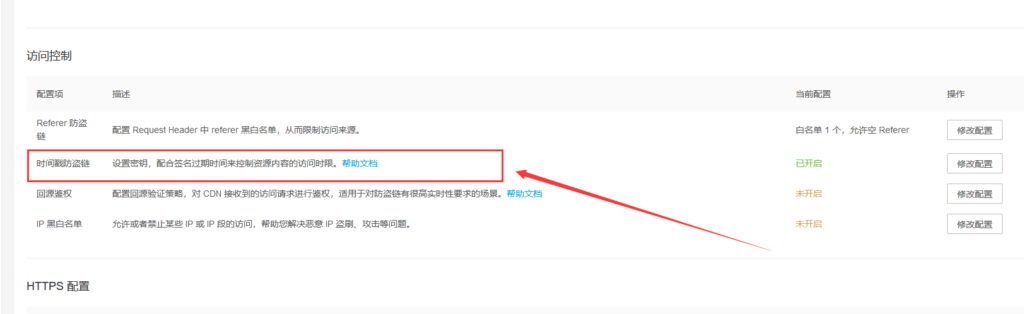

Resource origin authentication and timestamp-based anti-spoofing are both common technical measures used to protect resources against unauthorized access; each has its own advantages and disadvantages – the appropriate solution can be selected based on specific requirements.
Return Source Authentication:
- Advantage: Source-based authentication determines whether to grant access to the original content on the source server by verifying the authentication information contained in the request. This approach offers greater flexibility, as it allows for the configuration of various authentication rules based on specific requirements, enabling more granular access control.
- Disadvantages: Source-side authentication requires authentication between the CDN and the source server, which may increase request processing time and network overhead. Additionally, the management and updating of authentication information require corresponding policy and resource investments.
Timestamp-based防盗链:
- Advantage: The timestamp-based防盗链 mechanism involves adding a timestamp parameter to the resource URL, ensuring that each request URL is unique. By verifying the timestamp within the URL, it is possible to determine whether a request is valid. This approach is simple and easy to implement, as it requires no additional authentication steps.
- Disadvantages: The timestamp-based防盗链机制 is relatively simple, and its authentication mechanism is rather rudimentary, making it vulnerable to attacks by malicious users. Since a new URL must be generated for each request, this increases the URL length and reduces the cache hit rate, which may adversely affect the performance of the CDN cache.
Overall, source-based authentication offers more flexible and granular access control capabilities, making it suitable for scenarios requiring advanced resource protection and access permission management. In contrast, timestamp-based anti-link-hijacking is simpler and more convenient, ideal for scenarios with较低 security requirements or where the resources themselves are not particularly sensitive. The choice between these two approaches should be based on actual requirements and the desired level of resource protection.