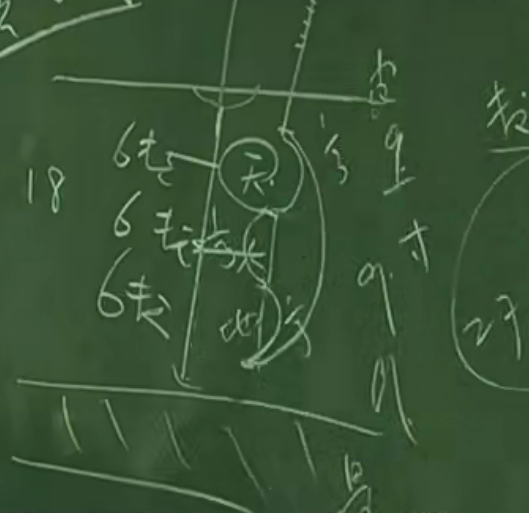

Ren pulse pulse originates from the cell
The Chong meridian opens an inch outside the Ren meridian and coincides with the Kidney meridian.
Problems in a woman’s uterus are all caused by the Ren channel, and the Chong channel can also be used.
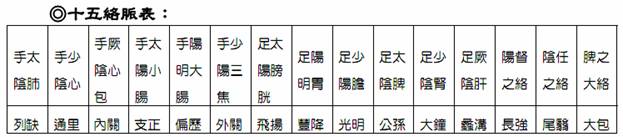
Eight extraordinary meridians and corresponding acupoints
Governor Vessel ---Houxi
Renmai ---missing
Chongmai ---Gongsun---Pulmonary heart and chest
Take pulse---feetcrying---Three strips, surrounding the waist and abdomen
Yang Qi pulse---Shenmai---Taoyang Point (郄Point)---Start from the outer ankle---From the back of the neck to the top---Yin slows and Yang rushes (ankle eversion)
Yin Qiu pulse---Teruhai---Start from the inner ankle--pass through the throat
Yang Wei Meridian---Holding all Yang Meridians together---foreign customs---circle around the chest
Yin dimension pulse---Neiguan---around the vagina, internal organs---a circle inside the ribs
Administer the right needle
Throat disease---Ren meridian, Yin Qiu meridian---Zhaohai, Lieque
Low back pain and chest pain---Yangwei pulse, belt pulse---Waiguan, crying
Xiang Qiang, stiff neck---Du Vein, Yang Qiu Vein---Hou Xi, Shen Vein
Song of the Eight Meridians (Medical Classic Primary School)
The Du Vein starts from the lower acupoint, goes up to the Fengfu in the spine, passes through the brain, forehead and nose, and enters the gum junction, which is the outline of the Yang Vein.
The Ren meridian originates from the bottom of the middle pole, runs along the upper abdomen along the throat, and is called the sea pregnancy of the Yin meridian.
The Chong pulse exits the cell and runs along the spine, from the abdomen to the pharynx and the lips. The female meridian becomes the blood chamber, and the pulse merges with the kidney meridian of Shaoyin.
With Ren Du originating from Yin Hui, the three meridians arise together and move in different directions.
The Yang Qiao starts from the inside of the heel and goes along the outer ankle to enter the Feng Chi.
The medial malleolus of Yin Qiao flows along the throat, and there are separate branches of Yin and Yang pulses in this foot.
All the Yins intersect to form the Yinwei pulse, and Shaoyin is sent out to build Binqie.
The Yang Wei Vein arises from the meeting of all the Yangs, and the Qiejinmen point of the Yangtze River arises.
The pulse circulates back to Ji Xiang and meets at Wei Dao Foot Shaoyang.
The so-called eight meridians of the strange meridians, all meridians are normal.
Eight Extraordinary Meridians (Eight Meridians)
The Du meridian originates from the center of the bones below the lower abdomen. In women, it enters the ting hole, which is the end of the foramen. Its collaterals follow the yin organ, join the middle, go around the back, and don't wrap around the buttocks, at least yin. It joins the Shaoyin with the juyang middle meridian, and runs through the inner and posterior surface of the upper thigh. It runs through the spine and belongs to the kidney. It originates from the inner canthus of the eye with the sun. On the forehead, above the top of the joint, it enters the collaterals and brain, and exits the other lower part of the neck, along the shoulders and arms, the chivalrous spine reaches the middle of the waist, and enters the pelvic collaterals and kidneys. For men, it goes down the stem to the urinary tract, which is equal to that for women. On the lower abdomen, it goes straight up to the center of the navel, goes up to the heart, enters the throat, goes up to the forehead and lips, and connects to the center below the eyes.
The Du Vein starts from the acupuncture point of the lower pole, goes to the spine, goes up to Fengfu, enters the top of the brain, follows the forehead to the pillar of the nose, and belongs to the sea of Yang Veins. It is a disease, the spine is strong and faint, and there are twenty-seven points. The acupuncture point is seen before.
Both Ren and Chong meridians originate in the cells and follow the spine, forming a sea of meridians. If it floats to the outside, it goes up along the abdomen, meets the throat, and binds to the lips. If the blood Qi is strong, the muscles will be hot. If the blood is excessive, it will infiltrate into the skin and produce vellus hair. If a woman has excess Qi but not enough blood, she may suffer from excessive menstruation and injury. The intersection pulse of Ren Chong does not connect to the lips and mouth, so the mustache will not grow.
The Ren meridian starts from below the Zhongji, above the hairline, along the abdomen, up to Guanyuan, to the throat and pharynx, and belongs to the sea of yin channels. It is a disease characterized by painful internal knots, seven hernias in men and lumps in women. There are twenty-four points. The acupuncture point is seen before.
Chong meridians and Ren meridians both originate from the cell and go up the spine, forming a sea of meridians. If it floats on the outside, it goes up along the abdomen, meets the throat, and touches the lips. Therefore, it is said: "The Chong meridians originate from Qi Chong, go along the meridian of foot Shaoyin, go up through the navel, go to the chest and disperse; it is also a disease, causing people to have dyspepsia due to adverse qi." "The Difficult Sutra" says: "It is combined with the Sutra of Yang Ming." ’ Examining the acupoints, it is found that the left and right sides of Zuyang Mingxia’s navel are two inches upward. The left and right sides of the foot Shaoyinxia's navel go up one inch each. Contained in "Acupuncture Classic". Chongren and Du meridian originate from the perineum together, and run in the abdomen to Youmen, Tonggu, Yindu, Shiguan, Shangqu, Xingshu, Zhongzhu, Siman, Qixiao, Dahe and Henggu. All twenty-two points are classified into Shaoyin. However, the Chong meridians and the sufficient Shaoyin meridians will be clear.
Pylorus (beside Juque) Tonggu (beside Shangwan) Yindu (below Tonggu) Shiguan (below Yinzhu) Shangqu (below Shiguan) Xingshu (below Shangqu) Zhongzhu (below Xingshu) Siman (below Zhongzhu) Qixiao (below Siman) Dahe (below Qixiao) Henggu (below Dah)
The person with the pulse starts from the Jijie and turns around for one week. It is a disease characterized by fullness in the abdomen and swelling of the waist as if sitting in water. It is caused by the Qi of the pulse, which is rightly called Dai Pulse, because it makes one turn around like a belt. It also meets with the Foot Shaoyang at the Dai Pulse, the Five Pivots, and the Wei Dao, and is originated from the Dai Pulse. Every six points.
Daimai (one inch and eight minutes below Jijie) Wushu (three inches below Daimai) Weidao (five inches and three minutes below Zhangmen)
The Yang Qiao pulse originates from the middle of the heel, goes up along the outer ankle, and enters the Fengchi. It is a disease that makes the yin slow and the yang urgent. The two foot Qiao meridians are different from each other and merge with the sun. When the Qi goes up and returns together, the eyes will be wet. If the Qi is not active, the eyes will not close. Men count their Yang and women count their Yin. Those that should be counted are called meridians, and those that are not counted are called collaterals. The Qi pulse is eight feet long. The acupoints originate from the Shen pulse, originate from Pu Shen, Qie from Fu Yang, meet with Zu Shaoyang at Ju Liao, meet with Hand Yang Ming at the shoulder and Jia Gu, meet with Hand Yang Ming and Yang Wei at Jianshu, meet with Hand Yang Ming with Di Cang and Ju Liao, and meet with Ren Mai and Foot Yang Ming at Chengqi. There are twenty points.
Shenmai (below the outer ankle) Pushen (below the calcaneus) Fuyang (outer and heel) Juliao (below the Zhangmen) Jiankui (shoulder end) Jugu (shoulder end) Jishu (top of the back of the shoulder bone) Dicang (next to the muzzle) Juliao (both sides of the nose) Chengqi (seven points under the eyes)
The Yin Qiao pulse also originates from the middle of the heel, goes up along the medial malleolus, reaches the throat, and intersects with the Chong pulse. It is a disease that causes Yang to be slow and Yin to be urgent. Therefore, it is said: "The Qiu pulse is the difference between Shaoyin. It originates from behind the Ran Gu, above the upper medial malleolus, goes straight to the upper Yin, enters the Yin along the yin thigh, goes up the chest, enters the missing basin, comes out in front of the person's welcome, enters the nose, belongs to the inner canthus of the eye, and joins the sun. Women use it as a meridian, and men use it as a collateral. "The Qiu pulse of both feet is eight feet long, and the Yin Qiu point is at Jiaoxin. For patients with Yin Qiu disease, these are the four points.
Zhaohai (below the medial malleolus) Jiaoxin (above the medial malleolus)
The Yang-dimensional pulse is based on the Yang. Its pulse originates from the meeting of the Yang dimensions, and both maintains the yin dimension in the body. If Yang cannot maintain Yang, Rongrong cannot maintain itself. Its pulse Qi originates from Jinmen, Qie Yuyangjiao, joins the Taiyang and Yangqiao pulses of the hands at Zhenshu, joins the Shaoyang of the hands at Zhenhui, joins the Shaoyang of the hands and feet at Tianliao, and joins Shaoyang of the hands and feet and Yangming of the feet at Jianjing. It is on the head, meets the foot Shaoyang at Yangbai, goes up to Benshen, Linqi, Eye Window, goes up to Zhengying, Chengling, follows the brain void, goes down to Fengchi, Sun and Moon; when it meets the Governor Channel, it goes to Fengfu and Yamen. It is a disease with bitter cold and heat. There are thirty-two points.
Jinmen (below the outer ankle of the foot) Yangjiao (above the outer ankle) Zhenyu (above the back of the shoulder) Zhenhui (in front of the shoulder) Tianliao (above the missing basin) Jianjing (above the shoulder) Yangbai (above the eyebrow) Benshen (qu) Next to Cha) Linqi (above the eyes) Eyes window (after Linqi) Zhengying (behind the eyes window) Chengling (behind the Zhengying) Naukong (after Chengling) Fengchi (below the brainkong) Sun and Moon (below the Qimen) Fengfu dumb door
The Yin-maintaining pulse is maintained by Yin, and its pulse originates from the intersection of Yin. If Yin cannot be maintained by Yin, one will feel frustrated and lose his ambition. The Qi of the pulse originates from the Qie of the Yin dimension, which is called Zhubin. It joins with Zu Taiyin at Ai and Daheng in the abdomen. It also joins with Zu Taiyin and Jueyin at Fu She and Qi Men. It joins with Ren pulse at Tiantu and Lianquan. It is a disease with painful heartache. Every twelve points.
Zhubin (above the medial ankle) Abdominal mourning (below the sun and moon) Daheng (below the abdominal mourning) Fushe (below the abdominal knot) Qimen (below the breast) Tiantu (below the throat) Lianquan (above the throat)