
Hongmu Notes
Home Language Notes

Language Notes

In PHP regular expressions, how do you replace a character when the string you want to replace contains the '|' character itself?

In PHP regular expressions, how do you replace a character when the string you want to replace contains the '|' character itself? Language Notes PHP

In PHP, you can use the `preg_replace()` function to replace tab characters in a string. In regular expressions, a tab character is represented by `|`. To replace a tab character with another character, you can use the `$1` placeholder to specify the replacement character; for example: `$str = "This is a string containing a | character"; $str = preg_replace('/\|/', 'Replacement character'...`
👁 169
EmpireCMS – Using PHP to call navigation tags (Simple & Clear Version)

EmpireCMS – Using PHP to call navigation tags (Simple & Clear Version) Language Notes PHP

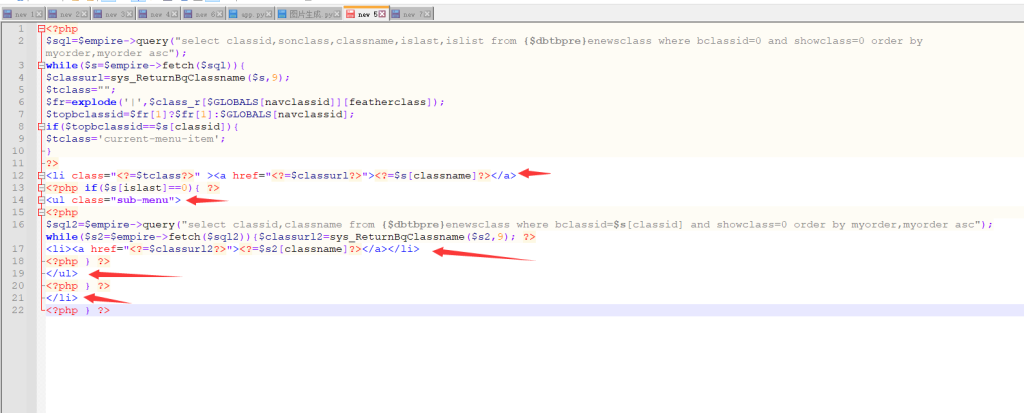
I originally used PHP to generate a navigation menu, but since many of you don't have PHP experience, I received numerous feedback requests. As a result, I've revised the code – this time, I've separated the PHP logic from the HTML markup. After this separation, the code is now much clearer. Compared to my previous article titled "Advanced PHP Code for Generating Empire Navigation Menus," you'll find that even those with just a basic understanding of HTML can easily comprehend and apply these changes! Here is the code: 🔒...
👁 398
Use PHP regular expressions to replace specified content exactly once (Method 2)

Use PHP regular expressions to replace specified content exactly once (Method 2) Language Notes PHP

You can use the `preg_replace` function in PHP to perform a single regular expression replacement on specified content. This function uses a regular expression to search through a string and replaces all matching occurrences with the specified replacement string. Here is an example code snippet that replaces the first match in a string with a specified value: $string = 'This is a test string.'; $p...
👁 136
Use PHP regular expressions to replace specified content – replace it only once.

Use PHP regular expressions to replace specified content – replace it only once. Language Notes PHP

To replace specific content with regular expressions in PHP, but only once, you can use the `preg_replace_callback()` function. This function accepts three parameters: the string to be replaced, the replacement string, and a callback function. The callback function is a custom function that is executed during the regular expression search and replacement process. Here is an example: $string = "Hello, world...";
👁 208
Combine multiple Python articles into a single article.

Combine multiple Python articles into a single article. Language Notes python

A friend mentioned needing to combine multiple Markdown-format files or articles into a single document. The requirement is quite simple: merge several TXT files from a folder into one document in sequential order. The output format should be as follows: <h3>Document 1 – File Name</h3> – Document 1 Content <h3>Document 2 – File Name</h3> – Document 2 Content <h3>Document 3 – File Name...
👁 201
What is the code to retrieve files from a folder in PHP?

What is the code to retrieve files from a folder in PHP? Language Notes PHP

To retrieve all files within a folder using PHP, you can use the `glob()` or `scandir()` functions. Below are example codes for both methods: `glob()` function: The `glob()` function accepts a single parameter and returns an array containing all files and directories that match the specified pattern. To retrieve all files in a directory, you can use the following code: `$files = glob('/path/...');`
👁 191
When querying a database using PHP, can `Mysqli::real_escape_string` be replaced with another function?

When querying a database using PHP, can `Mysqli::real_escape_string` be replaced with another function? Language Notes PHP

mysqli_real_escape_string is a built-in PHP function and is one of the more commonly used methods to prevent SQL injection attacks. To replace it with other functions, it is required to have the function of escaping special characters. For example, you can use the PDO::quote function and bindParam method in PDO to achieve the same effect. You can also use the addslashes function for escaping. …
👁 168
Prevent SQL injection when php queries the database

Prevent SQL injection when php queries the database Language Notes PHP

There are two main ways to prevent SQL injection in PHP: Use prepared statements. Preprocessed statements prepare query statements in advance and then pass parameters to the query statements. This can prevent SQL injection attacks. In PHP, we can use PDO or mysqli extension to implement prepared statements. The following is a sample code for using mysqli to implement prepared statements: // Database connection $host = 'lo…
👁 176
In php, is it dangerous not to set web cookies?

In php, is it dangerous not to set web cookies? Language Notes PHP

Not setting cookies does not directly cause danger, but in some cases it may reduce user experience and security. First, if the cookie is not set after the user logs in, the user will be required to log in again every time he reopens the page. This will increase the complexity and time consumption of user operations and reduce user experience. At the same time, if the user forgets to log out or closes the browser, account security cannot be effectively protected. Secondly, if in certain scenarios...
👁 186
PHP uses regular expressions to extract image links from an article, then downloads the images locally and replaces the original image links within the article.

PHP uses regular expressions to extract image links from an article, then downloads the images locally and replaces the original image links within the article. Language Notes PHP

In PHP, to extract image links from an article using regular expressions and download the images locally, you can follow these steps: 1. Extract the article text that needs to be processed from the webpage's source code; 2. Use regular expressions to match the image links within the text: `preg_match_all(' <img.+?src=[\"\'](.+?)[\"\']*?>/i', $content, $matches);`
👁 394
1 7 8 9 10 11 33